
The God Who Feeds: A Story Bigger Than Our Hunger
Frame / Excursion
If you read the Bible with one question in your mind – “What kind of God is this?” – one of the answers that keeps returning is wonderfully simple: this is a God who feeds. A God who pays attention to hunger. A God who delights to nourish human beings, body and soul, so that they can flourish in his presence.
The very first pages of Scripture carry this truth like a signature. Eden is not only a garden; it is a table. Trees heavy with fruit speak of a God who provides before Adam and Eve even know they need anything. Food is not an afterthought. It is a gift woven into creation itself. God feeds because God loves. And human beings eat because they are made to receive, not to self-sustain.
Move forward in Scripture and you find the same pattern expressed in new settings. When Israel wanders the desert, panicked by the emptiness around them, God answers not with scolding but with bread. Manna appears with the morning light, a sign that God’s care will rise with every dawn. Yet alongside the physical gift comes a lesson that shapes Israel’s faith: humans do not live by bread alone but by every word that comes from the mouth of the Lord. The manna feeds their bodies, the word feeds their souls. These are not competing meals. They are a single expression of God’s desire to nourish his people completely.
Elijah discovers the same truth in his lowest moment. Exhausted and despairing, he collapses under a tree. God sends an angel. And what does the angel bring? Bread. Water. Rest. Only after Elijah has eaten and slept does God speak to him in the still, small voice. Again, the pattern holds: God meets the physical need and the spiritual need side by side. God restores him in both ways at once.
The psalms gather all these threads and sing them. “Taste and see that the Lord is good.” To taste is a physical act, but the goodness tasted is spiritual. It is a way of saying that God’s generosity is not just an idea to ponder but a reality you can bite into. God feeds. God satisfies. God nourishes.
And then the prophets stretch the frame further still. Isaiah pictures a banquet laid for the weary and the broke, a feast where the thirsty drink freely and the hungry delight in rich food at no cost. Here is God as host, spreading a table for those who have nothing to offer in return.
By the time we reach the New Testament, this theme has become unmistakable. Feeding is part of the very identity of God. To meet hunger is to reveal his heart. And so, when Jesus steps onto the hillside in John 6, surrounded by a crowd with rumbling stomachs and restless hopes, we are meant to recognise what is happening. This is not a new impulse. This is the ancient, faithful God doing what he has always done, now through the human hands of his Son.
This is the frame we carry into the story:
A God who feeds the whole person.
A God who meets physical hunger and spiritual longing without diminishing either.
A God whose generosity is not occasional but characteristic.
And when we see Jesus with the bread in his hands, we are watching that story reach its fullest expression. In a few moments we will step into that scene, but first hold this truth firmly: the hands of Jesus are doing what the heart of God has always done. They feed. They nourish. They give life.
Bread for Hungry Bodies: Jesus Meets the Need in Front of Him
Biblical Story
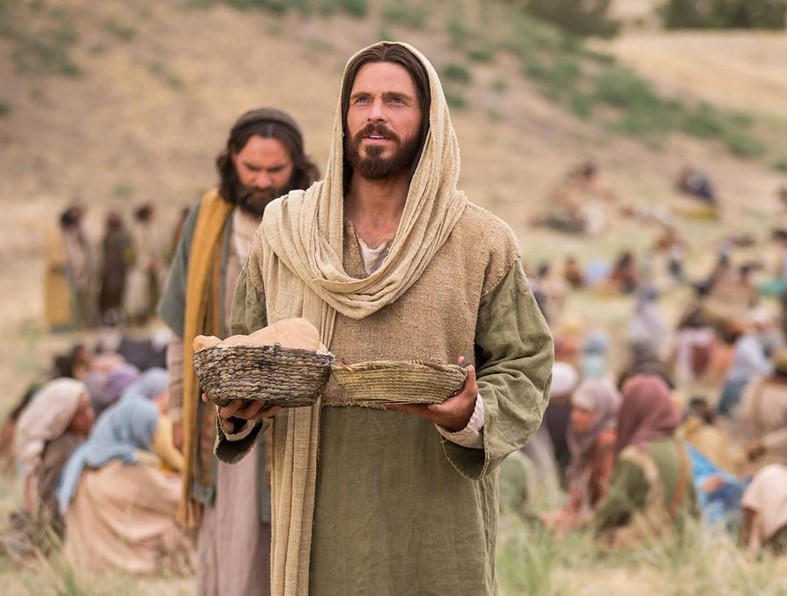
Imagine the scene on that hillside. A vast crowd scattered across the grass, families and travellers carrying the weariness of a long day. Children restless. Adults anxious about how far they are from home. The light beginning to soften as evening approaches. And underneath it all, that most ordinary and unavoidable of human realities: hunger.
Jesus sees it immediately. He does not treat their need as a distraction from his ministry or as a spiritual metaphor waiting to be uncovered. He treats it as what it is. People are hungry. They need food. And the God who feeds his people in every generation has not changed character.
The disciples feel the weight of the moment but not the possibility. They look at the crowd, then at the tiny offering of loaves and fish, and conclude that there is simply not enough. Their vision collapses under the maths. It is a familiar response. We often do the same when faced with need that exceeds our resources. We assume the little we have is unusable.
But watch what Jesus does. He takes real bread into his real hands. Not symbolic bread or metaphorical nourishment. Actual sustenance, still warm from the boy’s bundle. He blesses it, breaks it and hands it back to the disciples for distribution. And in those hands, simplicity becomes abundance. Scarcity becomes sufficiency.
Notice how physical the moment is. You can imagine the texture of the loaves as they tear. You can picture the disciples moving among the people, each piece placed into an open hand. Jesus feeds their bodies because he cares for their bodies. He honours their immediate need before he speaks to their deeper one.
Here is the God who fed Israel in the wilderness, now feeding his people again in a field by the sea. Nothing is too small for his compassion. No hunger goes unnoticed.
Food That Endures: Jesus Names the Deeper Hunger
Biblical Story
The feeding itself ends with satisfaction and silence on the hillside. But the conversation that reveals its deeper meaning comes the next day, after the crowd has searched for Jesus and followed him across the water to Capernaum. They track him down still thinking about the bread they had eaten, still wondering whether there might be more.
Jesus welcomes their questions, yet he also knows why they have come. He says, with a kindness that still carries challenge, “You are looking for me not because you saw the signs, but because you ate the loaves and were filled.” In other words: your hunger yesterday was real and I honoured it, but there is another hunger at work too, one you have not yet named. Then he adds, “Do not work for food that perishes, but for the food that endures to eternal life.”
He is not scolding them. He is unveiling something.
The bread they received was good, necessary and God-given. But it was not the whole gift. Yesterday he fed their bodies. Today he wants to offer them something that will feed their spirits. One kind of hunger drove them up the hillside; another has driven them across the lake. Jesus meets both with equal seriousness.
This is not a dismissal of physical need. The miracle has already proved that he honours it. Instead, Jesus is helping them see that human hunger has layers. Stomach hunger and soul hunger. Need for bread and need for eternal life. Food for today and food that endures.
His words echo the great story of Scripture: manna filled stomachs and taught trust; Elijah needed a loaf and a word; Isaiah promised rich food and the restoration of the heart. Jesus stands in that same stream, holding both kinds of nourishment together.
He is naming a truth we often forget. We can be physically full yet spiritually empty. And we can be physically needy yet spiritually starving for hope long before our next meal. Jesus does not force us to choose between those hungers. He simply refuses to ignore either one. He knows what we need, and he offers life that reaches deeper than bread alone.

The Work of Belief: The Hands That Receive
Biblical Story
The crowd, remembering the bread in their own hands only the day before, asks Jesus what they must do to secure this kind of life again. It is the natural human instinct to grip, to earn, to hold something up and say, “Here, this proves I deserve more.” We want to bring our own handful of effort. We want to show we have worked for the food that lasts.
Jesus answers in a way that gently pries their fingers open. “The work of God is this: to believe in the one he has sent.”
The whole conversation shifts back to a simple posture, because belief is not something you manufacture. It is something your hands admit. Yesterday, on the hillside, the meal began in his hands, not theirs. They watched his fingers lift the loaves in blessing. They saw his hands break the bread. They received piece after piece placed into their palms. Every movement of that miracle passed through his touch. Their hands were not the hands that created abundance. Their hands were simply the ones held open.
Now Jesus tells them that spiritual nourishment works in that same tactile way. Eternal life is not harvested through our grip or crafted through our skill. It comes from his hands to ours. The first act of belief is not to do, but to open. It is the bodily admission that we depend on him, that our hunger cannot be satisfied by our own strength.
We often struggle with that. We would rather clench our fists around our own performance. If we behave better. If we pray harder. If we prove ourselves worthy. Then surely God will feed us with what lasts. But Jesus does not speak the language of clenched fists. He speaks the language of open hands. His hands give freely. Ours receive first.
Belief is a physical movement of the soul, the willingness to lift our empty hands towards the one who never stops feeding. It is trust with skin on it. It is the simple, earthy confession that the life we long for comes from his hands alone.

As Jesus’ hands did, so we too must
Frame / Excursion
We have watched Jesus feed a crowd with ordinary bread. We have seen his hands bless, break, and give until scarcity became abundance. We have heard him speak of a deeper nourishment that satisfies the hunger beneath all hungers. And we have recognised that belief is not something we earn with clenched fists, but something we receive with open hands.
Now the scene turns. The miracle on the hillside is not only a revelation of who Jesus is. It is an invitation to who we are becoming. For if his hands reveal the generosity of God, then our hands, as members of his body, are meant to carry that generosity into the world.
Paul says, “You are the body of Christ.” That means your hands are now part of his work. The hands that once received his generosity become hands that extend it.
This remains practical before it becomes anything else. There are empty cupboards in our towns. There are neighbours who stretch meals through the week. There are people who eat alone because no one invites them to a table. The hands of Jesus fed the hungry on a hillside. The hands of his people can feed the hungry round here.
It is hospitality shared around a table. It is generosity in the weekly shop. It is supporting those in need through our community ministries. It is bringing food, cooking meals, noticing someone’s hunger and refusing to let it remain invisible. When our hands give actual bread, they echo the miracle more clearly than any sermon ever could.
But this calling is not only practical. It is also spiritual. Just as Jesus fed bodies and pointed toward a life that endures, our hands can offer both kinds of nourishment. We can hold Scripture with someone who is starving for hope. We can pray with a friend whose heart feels empty. We can guide a young believer to the Bread of Life. These are also acts of feeding. These too are the work of his hands now done through ours.
So here is the invitation for us all, simple and profound. If Jesus’ hands blessed and broke bread so others could live, then our hands must move in the same direction.
As Jesus’ hands fed, so we too must feed. As his hands opened in generosity, so ours must open. As his hands offered life, so ours must offer life.
May our hands, in his service, become hands that feed.