We all have songs that transport us. A certain chord progression, a lyric, a melody — suddenly you’re moved, stirred, even reverent. It might be a worship song. It might be Coldplay. Or a football anthem. Or a national hymn. And sometimes, we don’t stop to ask: what exactly am I being moved by?
Amos’s audience didn’t lack music. They had choirs and temples, feasts and harps. But God wasn’t applauding. In fact, God was covering His ears. Worship had become noise. Beautiful, professional, impressive noise — but noise nonetheless. Because something essential was missing.
What Amos exposes — and what we need to confront — is this unsettling truth: not all that sounds holy, is holy. Not all that feels spiritual, is faithful. Not all that moves you is from the Spirit of God. And sometimes the thing that needs retuning is not the music, but the heart behind it.
When the music’s good and the stage is polished, it’s easy to forget to ask what story our worship is really telling. But this kind of forgetting isn’t new. Israel had been here before. They had once before chosen a worship style that felt familiar, politically convenient, emotionally stirring — but entirely false. To understand what Amos is confronting, we need to go back to the moment it all began … to revisit the choices of a king named Jeroboam. For what he built still echoes in Amos’s day — and maybe in ours too.
David’s Harp, Jeroboam’s Idol
Text: Biblical Background:
You could almost admire Jeroboam’s strategy — if it weren’t so devastating. Faced with the fear that Israel might return to King Rehoboam of Judah if they kept going to the temple in Jerusalem, Jeroboam made a political decision: set up rival worship sites. Build two golden calves — in Bethel and Dan. Appoint his own priests. Invent new festivals. He even told the people: “Here are your gods, O Israel, who brought you up out of Egypt.”
It had all the trappings of religion: sacred places, ceremonies, music, leadership. But it was a calculated move to preserve control, not to honour God. The worship looked familiar — but it wasn’t faithful.
Fast forward to Amos’s day. The Northern Kingdom is thriving economically. The temple at Bethel is flourishing. The music is flowing. People are worshipping — regularly, fervently, musically. But God sees through it. They may be singing like David, but they’re living under Jeroboam’s logic.
In Amos 6:5, the prophet takes a direct swipe: “You strum away on your harps like David and improvise on musical instruments.” That’s a charge, not a compliment. They’ve co-opted David’s sound without David’s spirit. They’ve dressed up disobedience in the language of worship. Amos pinpoints their music, not because music is evil, but because their music is now mimicking something holy. They are merely “strumming like” David: they appear devout, yet they are just letting this appearance dig them further into a spiritual delusion.
It’s a warning that worship style can mask spiritual compromise. That performance can replace presence. That we can sing passionately while drifting dangerously.
The Danger of Beautiful Lies
Application pt1: Central Message
It’s entirely possible to sing David’s songs while living Jeroboam’s life. To raise your hands, hit every harmony, and still miss the heart of God.
That’s Amos’s accusation: His phrase “strum your harps like David” is not just that they play music, but that they deliberately evoke the golden age of Israel’s worship. They co-opt the emotional and spiritual memory of David’s intimacy with God. But they do so while living lives David would never have endorsed: full of self-indulgence, exploitation, and disregard for the ways of the Lord.
This is the seductive danger of beautiful lies — forms of worship that look and sound right, but are detached from the life of obedience and love that true worship entails. Imitation does not equal intimacy. Atmosphere isn’t the same as adoration.
What makes it even more troubling is that this imitation is not accidental — it’s strategic. Jeroboam I, the original northern king, had deliberately restructured Israel’s worship to make it more convenient, more accessible, and more politically useful. He didn’t abolish worship; he co-opted it. He preserved the songs, the festivals, even the vocabulary of devotion — but hollowed them out, reoriented them around national pride and political control. Centuries later, Amos sees how thoroughly that legacy has sunk in. Worship has become theatre. Music has become performance. The temple is a place of feeling, not formation.
This critique isn’t about music style. Amos never once mentions tempo or volume. The issue is dissonance — between the sound of our worship and the shape of our lives. When the aesthetics of worship become a cover for spiritual apathy or injustice or pride, it doesn’t matter how moving the melodies are. We’re no longer forming communion with God — we’re using God’s name to reinforce our own comfort.
This is why Amos’s words cut so deep. They’re not just a warning about false religion. They’re a mirror. Because we too know how to craft a moment. We know how to build an atmosphere. But if we are not careful, we can be lulled into a spiritual sleep where we mistake goosebumps for God’s presence.
The danger isn’t that our worship feels good — it’s that it might make us feel safe while we drift further from the One we’re supposed to be drawing near to.
Modern Echoes of Hollow Worship
Application pt2: Illustration
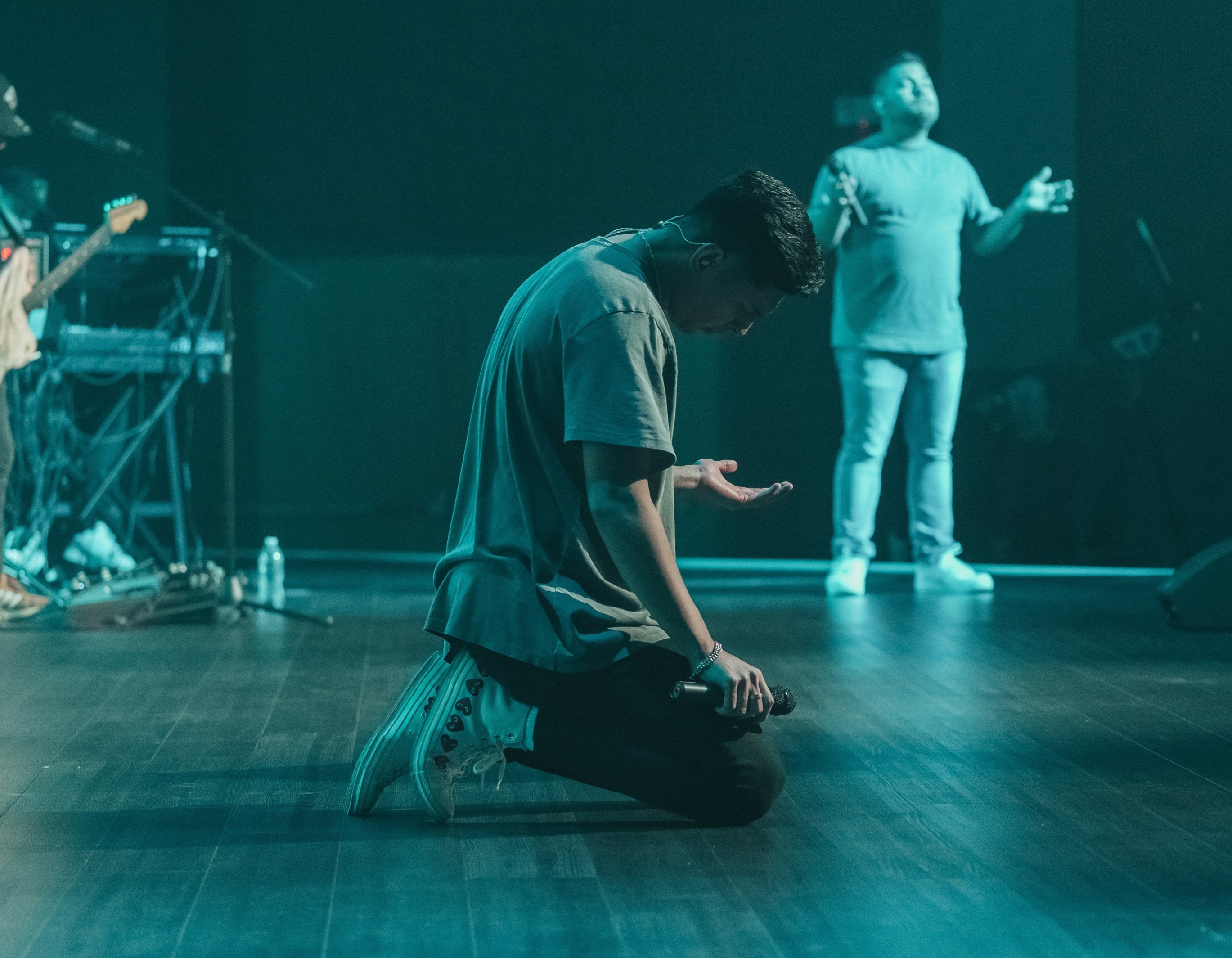
We probably all know what it’s like to walk into a church or conference and feel it — the buzz, the energy, the surge of emotion when the music swells and the lights warm the room just right. It feels alive with emotion so high it’s as if you are invincible. And that’s not a bad thing. God can absolutely meet us in those moments. But Amos forces us to ask a harder question: What happens next week, back home, when the dishes pile up and your temper flares and the music isn’t curated for you?
Too often, we settle for the high without the holy. The room was electric, the tears were real, the hands were raised — but the week that follows looks unchanged. The anger’s still there. The selfishness still lingers. We’ve felt something — but we’ve not been formed. We’ve confused being stirred for being sanctified.
The danger is that worship becomes therapy. We start showing up asking, “What will help me feel better this week?” rather than “What is God saying?” And over time, our time together becomes emotional medicine: a dose of relief, not a life of reverence. We look for peace, but not repentance. We want rest, but not reformation.
And slowly, subtly, worship becomes less about meeting the living God and more about curating a vibe. When that happens, we’re not far from Israel in Amos’s day. The music plays. The hands lift. But God is no longer listening.
This is not a call to kill the band or dim the lights. It’s a call to examine the heart behind the sound. To ask: Is this drawing me closer to God — or just deeper into myself?
Because true worship doesn’t just lift us up. It breaks us open. And it changes us.
Worship that forms us
Response pt1: Theological Frame
What set David’s music apart wasn’t the quality of the performance — though he was a skilled musician. What made it different was the quality of the heart. David’s music was not performance; it was a cry of the heart, a weapon of war, a vessel of lament and love. It was messy and raw, sometimes full of praise, sometimes full of questions. And yet through it all, it was a means of communion — with a holy, living God.
This is the kind of worship that forms a soul, not flatters it.
When David wrote, he wasn’t trying to create a moment — he was cultivating a life. His songs rose from the field, from the cave, from the battlefield, from the throne room. They were written with dirt on his hands and tears on his face. And through them, he was shaped — into a man after God’s own heart. Not a perfect man, but a formed one.
In contrast, the worship in Amos’s day had become a kind of theatre. Well-scripted, but spiritually hollow. They sang the right words with the wrong hearts. They offered up sacrifices while ignoring God’s voice. And God’s response is devastating: “Take away from me the noise of your songs.”
The truth is, our worship always shapes us. The only question is: Into what?
If our worship is rooted in self-comfort or emotional escape, it will deform us — teaching us to seek feelings instead of faithfulness, moments instead of maturity. But if it’s rooted in awe, in reverence, in repentance and hope, then it becomes a furnace. It will refine us, not flatter us. It will send us out different than we came in.
This is why God cares so deeply about how we worship. Not because He needs our songs — but because He desires our hearts. Worship isn’t about giving God what He lacks. It’s about opening ourselves to become what we were made to be.
Retuning the Harp
Response pt 2: Conclusion
So here’s the call: Don’t just sing like David — seek like David.
Let worship stretch beyond Sunday. Let it fill your week with truth and hunger. Let it move you to confession. Let it lead you into silence. Let it drive you to scripture, to service, to surrender.
Write your own Psalms — of joy and justice, of heartbreak and hope. Get out pen and paper and craft your own psalm. Dance with abandon when you know you’re free. Cry out when you’re not. Let your life be the instrument God tunes.
Because the danger Amos warns about isn’t just that we might worship wrongly — but that we might worship falsely. That we might sound like David but live like Jeroboam. That we might build golden platforms and call them altars.
But the invitation is still open. To return. To retune. To worship in spirit and truth. Not with perfect songs, but with honest ones.
God is not asking for performance. He is calling for presence. A heart yielded. A life turned toward Him.
Let’s not settle for songs He won’t listen to. Let’s offer the kind of worship that moves heaven — and changes earth.