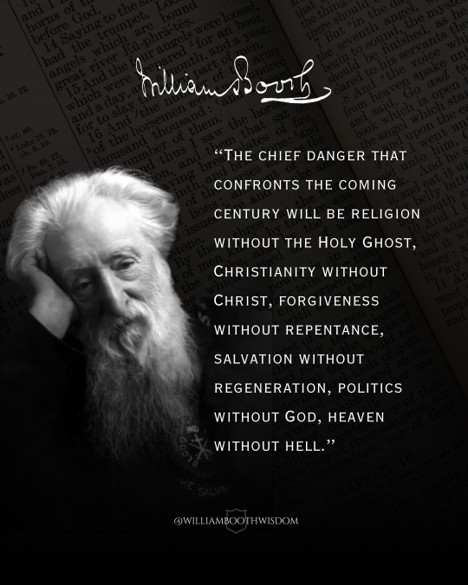
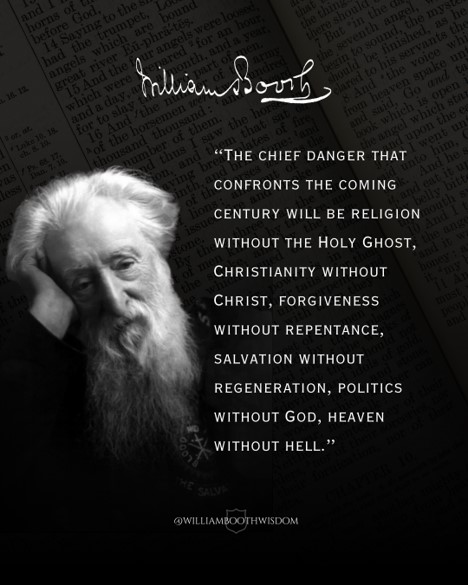
“The chief danger of the 20th century will be religion without the Holy Spirit, Christianity without Christ, forgiveness without repentance, salvation without regeneration, politics without God, and heaven without hell.” – William Booth
He said those words over a hundred years ago / in 18…. We are now living in the 21st century – a fact made clear to me when I was described as being more in the mid‑to‑late 1900s. But though Booth spoke those words over a hundred years ago, the danger has not passed.
In fact, we might say it’s matured. Institutionalized. Streamlined. Our buildings are open, our schedules full, our songs sung with conviction — and yet Booth’s warning echoes louder now than ever.
It’s not that religion has died.
It’s that religion without God might just have learned how to survive.
So today, I want to walk us through a portion of Amos — not all at once, not line by line — but through a series of windows.
Each story will bring us face to face with a fragment of Amos’s vision. And each one will ask us: What left when God withdraws?
As we move through these stories, I’ll let the words of Amos appear on the screen. Let them sit beside the images, the emotions, the questions that come.
This won’t be a sermon with three points.
It will be a journey through three rooms — each one still furnished, still beautiful in its way… but strangely empty.
The Abandoned House
Story 1
“The Lord God has sworn by himself—declares the Lord, the God of hosts:‘ abhor the pride of Jacob and hate his strongholds,and I will deliver up the city and all that is in it.’” (Amos 6:8)
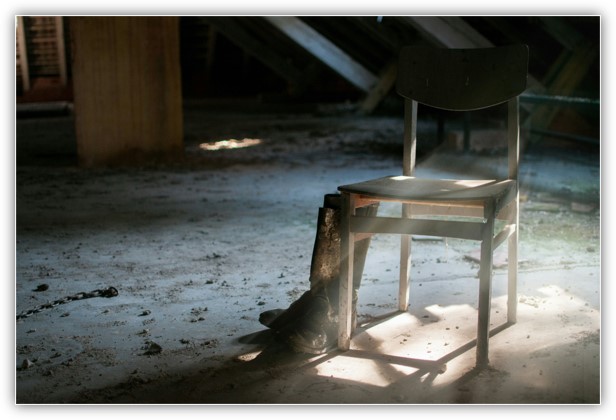
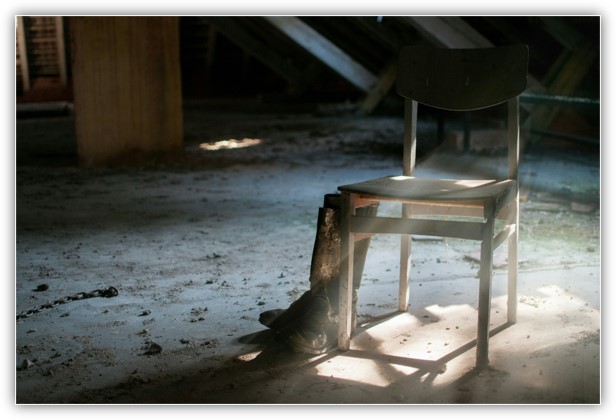
You arrive at the house after the war is over.
The front still stands. Stonework undamaged. Windows unbroken. There’s even a wreath on the door — faded, but still there.
Inside, it’s quiet. Not peaceful — eerie.
The furniture is neatly arranged, like someone was just here. A child’s toy lies on the floor. A photo album is half‑open on the table. A cup still rests in the saucer by the armchair. One of those chairs that rocks just a little when you walk past.
But there’s no one here.
You check the cupboards — untouched. You call out, “Hello?” — silence. And suddenly it hits you:
This house hasn’t been abandoned by force.
It’s been abandoned by absence.
Whoever lived here — they left in a hurry. Maybe long ago. But the house has remained, like a museum of life once lived.
This is where Amos begins.
The people are proud of their strongholds. Proud of their homes. Proud of their visible success. But the prophet sees the truth: the city still stands, yet God has left it.
And it’s possible for a people — even a worshipping people — to keep the appearance of life, even as the source of life is gone.
God doesn’t first bring fire or flood.
He withdraws.
And sometimes the first sign of judgment isn’t destruction…
…it’s the deafening quiet that follows when God walks away.
The Anniversary Dinner
Story 2
“And if ten people remain in one house, they shall die.And when one's relative, the one who burns the dead,shall take him up to bring the bones out of the house,and shall say to him who is in the innermost parts of the house,‘Is there still anyone with you?’ he shall say, ‘No’;and he shall say, ‘Silence! We must not mention the name of the Lord.’” (Amos 6:9–10)
She sits at the table in the corner booth, dressed for the occasion. A touch of perfume. A flick of eyeliner. She’s done this before.
It’s their anniversary — or would be, if he hadn’t left.
But no one knows that.
She still comes to the restaurant. Still orders his favourite dish. Still laughs at the jokes they used to share. The waiter, trained in discretion, smiles and pours two glasses of wine, as if nothing has changed.
To the world, this is loyalty.
To her, it’s denial.
To the truth — it’s a ritual with no relationship.
And in the corner of the frame, there’s a haunting silence.
That’s what Amos sees in Israel.
A household with rituals still in place.
Ten people left — then nine, then none.
Even in the face of death, the survivors whisper, “Don’t say His name.”
Why?
Maybe fear. Maybe reverence.
Maybe because the name no longer fits the room.
Maybe because mentioning the Lord might break the illusion that He’s still involved.
Sometimes, the silence after God withdraws is even louder than His voice.
And sometimes, the pretence of presence is harder to face than absence itself.
So Amos shows us this moment: a people still in the house…
but already living like He’s not.
The Slick Church
Story 3
“Do horses run on rocks?Does one plough the sea with oxen?But you have turned justice into poisonand the fruit of righteousness into wormwood.” (Amos 6:12)
You step into the sanctuary — and it’s beautiful.
The lights are warm, not blinding. The music is tight. The screen graphics are tasteful. Someone hands you a welcome card and a coffee that tastes like it didn’t come from a church.
Everything hums.
Then the worship starts.
The harmonies are perfect. The transitions are smooth.
The preacher knows when to smile, when to pause, when to quote C.S. Lewis and when to crack a joke.
You look around, and everyone’s clapping in sync – and not just on beats 1 and 3.
But something feels… off.
A teenager leans over after the service and whispers, “It felt like a concert. Only emptier.”
It’s hard to name what’s missing.
But you know when Presence is absent.
That’s the kind of absurdity Amos is naming.
“Do horses run on rocks?
Does one plough the sea with oxen?”
Of course not.
Horses break legs on rocks.
Oxen drown in the sea.
No farmer would attempt it.
But that’s what it looks like when the outward motions of worship continue —
even as the foundation has become unworkable, unstable, unholy.
It looks good. It even works… on the surface.
But it’s a grind. And it’s going nowhere.
And it slowly poisons what once bore fruit.
Because you can’t manufacture the presence of God.
You can’t program around His absence.
When God withdraws, you may still have music, plans, polish, and metrics.
But you don’t have Him.
And maybe worst of all — you might not even notice.
Still Standing, but Hollow
Theological Frame
The stories you’ve just heard aren’t really about buildings, or dinners, or polished services.
They’re about absence.
And not just any absence — God’s absence.
When Amos speaks in this section, he’s not describing fire from heaven or storms of judgment.
There’s no earthquake, no hailstones, no plagues.
Just… departure.
God doesn’t unleash destruction. He steps away.
And that — in Scripture — is the most frightening judgment of all.
You can rebuild after fire.
You can recover from disaster.
But when God leaves… what are you left with?
A home with no laughter.
A meal with no guest.
A worship set with no weight.
A ministry with no Master.
Still standing, still structured… but spiritually hollow.
This is not a punishment meant for “other people.” It’s a warning for those who think they’re fine — those who mistake God’s past blessing for present approval… those who believe that the exterior is enough.
And if that feels too abstract, just think of the stories again:
The house where everything is in place… but no one comes home.
The dinner table where devotion is performed… but the covenant is long gone.
The church that knows how to stir a crowd… but can no longer move heaven. One where everything works — except the Spirit.
God doesn’t always shout when He leaves.
Sometimes, He just goes silent.
And it’s possible — terrifyingly possible — to carry on as if nothing’s happened.
But something has.
Would We Notice?
Conclusion
We’ve heard three stories.
Each one carries the same haunting echo: What remains when God withdraws?
Amos paints a grim picture — but it’s not dramatic in the way we expect. There’s no fire from heaven. No thunderous wrath. Just… absence.
And so we are left with a piercing question: Would we notice if God left?
Would our Sundays still run smoothly?
Would our worship still sound impressive?
Would we still have plans, programs, polish?
Would we keep going — business as usual — and only later realise… that the Presence we sing about has already gone?
This isn’t a call to panic. It’s a call to honesty.
To pause.
To ask not whether we look alive… but whether we are.
Still standing isn’t the same as still indwelt. And imitation isn’t the same as intimacy.
So we must ask ourselves — individually and as a church:
Are we seeking the God who fills the house —
or just admiring the house He once filled?
Booth’s Warning
Epilogue
“The chief danger of the 20th century will be religion without the Holy Spirit, Christianity without Christ, forgiveness without repentance, salvation without regeneration, politics without God, and heaven without hell.”
Booth’s words were a warning — but also a description.
He spoke them over a hundred years ago.
But they echo in the world of Amos.
And they echo in ours.
Not with thunder,
not with fire,
but with silence.
Because God’s greatest judgment…
is to walk away from people who no longer notice He’s gone.
Let it not be true of us.
Let us hunger not for the form of godliness —
but for the fire.
For the Presence.
For the Spirit who still comes
where He is welcomed.
Amen – may it be so.